


Table of Contents
- What Deconstruction and Demolition Actually Are
- Key Differences Between Deconstruction and Demolition
- Deconstruction Cost vs Demolition: A Transparent Comparison
- Building Material Salvage and Reuse: Environmental and Financial Benefits
- The Deconstruction Process: Step-by-Step Execution
- When to Choose Deconstruction: Decision Framework
- Building age, condition, and material quality
- Hazardous materials and abatement impact
- Project timeline and schedule constraints
- Site constraints and logistics
- Material reuse potential and market conditions
- Environmental priorities and regulatory requirements
- Decision checklist: Deconstruction vs. Demolition
- Environmental Impact and Lifecycle Emissions
- Frequently Asked Questions
Last Updated: October 10, 2026
What Deconstruction and Demolition Actually Are
Understanding deconstruction vs demolition is essential, as these fundamentally different approaches to removing buildings each affect cost, timeline, environmental impact, and material recovery differently.
Deconstruction: Selective dismantling and material recovery
Deconstruction is the systematic disassembly of a building to recover reusable and recyclable materials. Workers manually separate structural components, dimensional lumber, metal, concrete, and other materials for resale or reuse rather than landfill disposal.
Teams carefully remove fixtures, flooring, roofing, windows, doors, and interior components before addressing structural elements. This selective dismantling requires skilled labor and meticulous planning.
Deconstruction generates significantly less landfill waste because salvageable materials, dimensional lumber, copper wiring, hardwood flooring, doors, fixtures, are sorted and resold or donated, supporting the circular economy.
The trade-off is time: deconstruction takes longer than conventional demolition because the work is labor-intensive and methodical.
Demolition: Conventional structural removal
Demolition is the rapid structural removal of a building using mechanical equipment. Excavators, wrecking balls, and specialized machinery break down the structure quickly, with waste sorted afterward into recyclable and landfill streams.
Conventional demolition prioritizes speed and cost efficiency. Once hazardous materials are removed, the site is cleared rapidly, with much waste going to landfill despite recycling efforts.
This approach works well for buildings where material salvage value is low, timelines are tight, or structural condition makes selective dismantling impractical.
Key Differences Between Deconstruction and Demolition
The core differences center on method, timeline, cost structure, environmental outcome, and material recovery potential.
| Aspect | Deconstruction | Demolition |
|---|---|---|
| Primary Goal | Material recovery and reuse | Rapid site clearance |
| Method | Manual selective dismantling | Mechanical structural removal |
| Timeline | Longer (weeks to months) | Shorter (days to weeks) |
| Labor Intensity | High (skilled trades required) | Moderate (equipment operators) |
| Waste to Landfill | Minimal | Moderate to high |
| Material Resale Value | Generates revenue | Minimal recovery value |
| Best For | Older buildings, high-value materials | New construction sites, tight timelines |
Deconstruction works best when buildings contain high-value materials: dimensional lumber from older structures, copper wiring, hardwood flooring, and architectural salvage. Resale value can offset labor costs, sometimes making deconstruction cost-competitive with demolition.
Deconstruction Cost vs Demolition: A Transparent Comparison
Cost comparison depends on material recovery value, labor rates, disposal costs, and site-specific conditions.
Labor and equipment costs
Deconstruction labor is the largest cost driver. Skilled trades workers manually disassemble components at $50-$85 per hour. A 2,000-square-foot residential building requires 400-800 labor hours ($20,000-$68,000) over 6-12 weeks.
Demolition labor is lower ($2,800-$8,800 for 80-160 hours), but heavy equipment rental, excavators, wrecking balls, debris hauling trucks, costs $8,000-$15,000 over 3-7 days.
Disposal and recycling costs
Demolition generates 80-120 tonnes of mixed waste. Landfill tipping fees ($40-$80/tonne) and recycling costs ($20-$50/tonne) total $4,800-$15,600 in disposal.
Deconstruction generates 4-18 tonnes of remaining waste (5-15% of building mass), with disposal costs of $160-$1,440.
Salvage value and revenue offset
High-value salvage materials include dimensional lumber ($4,000-$18,000), hardwood flooring ($3,000-$9,000), copper wiring ($800-$2,500), doors and windows ($750-$12,500), and architectural salvage ($500-$5,000).
Total salvage value for well-preserved older homes: $9,050-$47,000; for newer or poorly maintained buildings: $500-$3,000.
Demolition produces minimal salvage value ($500-$2,000) because materials are commingled and damaged during mechanical breakdown.
Tax deductions and local incentives
Material donations to registered charities may qualify for charitable tax deductions, offsetting 15-30% of deconstruction labor costs for higher-bracket taxpayers.
Some municipalities offer waste diversion rebates or tax credits for projects achieving 75%+ diversion rates.
Total project cost comparison: worked example
Scenario: 2,000-square-foot residential building, pre-1970s, good structural condition, salvageable materials present.
Deconstruction:
- Labor (600 hours @ $65/hour): $39,000
- Permits and planning: $1,500
- Hazardous material abatement: $2,000-$5,000
- Disposal of non-salvageable waste (10 tonnes): $400-$800
- Subtotal: $42,900-$46,300
- Less: Salvage revenue: −$12,000
- Less: Charitable donation tax deduction (25% marginal rate): −$3,000
- Net cost: $27,900-$31,300
Demolition:
- Labor (120 hours @ $45/hour): $5,400
- Equipment rental (5 days): $10,000
- Permits: $800
- Disposal (100 tonnes @ $60/tonne): $6,000
- Hazardous material abatement: $2,000-$5,000
- Total cost: $24,200-$27,200
Demolition is $3,700-$7,100 cheaper upfront, but deconstruction preserves $12,000+ in material value and diverts 85-95% of waste from landfill.
Key variables that shift the financial equation
- Building age and material quality: Pre-1980s buildings with solid-wood framing favor deconstruction; post-2000 buildings favor demolition.
- Local disposal and recycling fees: High landfill tipping fees favor deconstruction; low disposal costs favor demolition.
- Project timeline: 8-12 week timelines justify deconstruction; fixed 2-3 week timelines require demolition.
- Hazardous materials: Asbestos, lead paint, or PCB contamination adds $2,000-$10,000+ to both methods.
- Market demand: Strong local markets increase deconstruction’s revenue; weak markets reduce salvage value.
Bottom line: Compare total project cost (labor + equipment + disposal − salvage + incentives) rather than demolition cost alone.
Building Material Salvage and Reuse: Environmental and Financial Benefits
Material salvage and reuse create environmental and financial benefits extending beyond the demolition project itself.
What materials recover value and where they go
High-value salvageable materials include dimensional lumber, hardwood flooring, copper wiring, windows, and architectural trim. These are cleaned, graded, and resold through salvage retailers or building material reuse centers.
Reclaimed lumber finds markets in custom furniture, flooring, and new construction. Copper and metals are processed by scrap recyclers. Windows, doors, and fixtures are restored and resold, keeping embodied carbon in productive use.
Waste diversion and circular economy impact
Deconstruction supports waste diversion by design. Material recovery and sorting occur during dismantling, aligning with circular economy principles of extending material life cycles and minimizing landfill burden.
Demolition can achieve waste diversion through post-demolition sorting, but the process is less efficient because materials are mixed and contaminated during mechanical breakdown.
The Deconstruction Process: Step-by-Step Execution
Executing a deconstruction project requires careful planning, sequencing, and coordination across multiple phases.
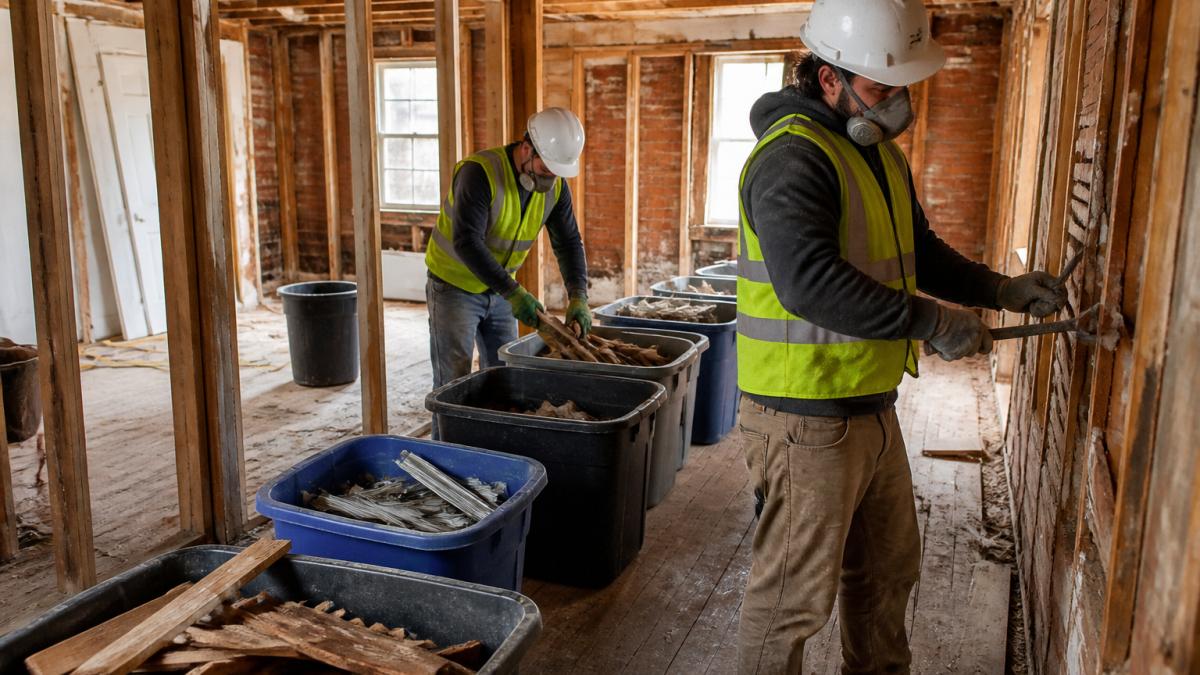
Hazardous material abatement and safety protocols
Before deconstruction begins, the building must be surveyed for hazardous materials. Asbestos, lead paint, PCBs, and other regulated substances must be identified and removed by certified abatement professionals.
Improper handling creates legal liability, worker safety risks, and regulatory penalties. Abatement adds time and cost but is essential for compliance.
Permits, regulations, and site coordination
Deconstruction projects require municipal permits and must comply with local building codes and waste management regulations, including site plans and waste diversion targets.
Utility disconnections must be coordinated with service providers. Site safety protocols, traffic management, and neighbor notification are standard. For dense urban areas, dust control and noise management are critical.
Coordinate utility disconnections early in planning. Delays in Hydro or gas company schedules can push back project start dates. Build buffer time into your timeline.
When to Choose Deconstruction: Decision Framework
The choice between deconstruction vs demolition requires evaluating building characteristics, project constraints, hazardous material burden, and environmental priorities against a practical checklist.
Building age, condition, and material quality
Age and material value:
- Pre-1950 buildings: Typically contain high-value salvageable materials. Strong candidate for deconstruction if structural condition permits.
- 1950-1980 buildings: Deconstruction is viable if material assessment shows $5,000+ in recoverable value.
- Post-1980 buildings: Limited salvage potential; demolition is typically more cost-effective.
Structural condition:
- Sound structure: Deconstruction is safe and practical.
- Moderate deterioration: Deconstruction becomes riskier and more expensive; may require temporary shoring. Demolition may be safer and more economical.
- Severe deterioration: Demolition is the only safe option.
Material quality assessment:
Conduct a material survey to estimate salvage value: inspect framing for solid wood versus engineered lumber, identify hardwood flooring, count doors and windows, and assess architectural elements.
Hazardous materials and abatement impact
Hazardous materials affect both cost and sequencing. Identify and plan before choosing a method.
Asbestos: Found in insulation, floor tiles, roofing, and pipe wrap (pre-1980s buildings). Both deconstruction and demolition require certified abatement ($2,000-$8,000, 2-4 weeks) before proceeding.
Lead paint: Found on pre-1978 buildings. Deconstruction requires lead-safe work practices (containment, HEPA vacuuming); demolition requires dust control. Both are viable.
Mold:
- Common locations: Basements, crawl spaces, areas with water damage or poor ventilation.
- Impact on deconstruction: Mold remediation must occur before selective dismantling. Affected materials may not be salvageable if contamination is extensive. Adds $1,000-$5,000 and 1-2 weeks.
- Impact on demolition: Mold is disturbed during mechanical breakdown, requiring containment and disposal as hazardous waste.
- Decision factor: Extensive mold contamination reduces salvage value and favors demolition because remediation cost is similar but demolition is faster.
PCBs (polychlorinated biphenyls):
- Common locations: Old electrical transformers, capacitors, fluorescent light ballasts (pre-1979 equipment).
- Impact on deconstruction: PCB-containing equipment must be removed by certified handlers before dismantling. Cost is $500-$2,000. Does not prevent deconstruction.
- Impact on demolition: PCB equipment is removed during or immediately after demolition.
- Decision factor: PCB presence does not strongly favor one method; both require removal before waste processing.
Hazardous materials summary: Asbestos, lead, mold, or PCBs add cost and timeline to both methods. Extensive contamination reduces salvage value and may favor demolition. Budget $2,000-$10,000 for abatement and add 2-4 weeks if hazardous materials are present.
Project timeline and schedule constraints
- Flexible timeline (8+ weeks available): Deconstruction becomes viable because extended labor cost is offset by salvage revenue and waste diversion benefits.
- Moderate timeline (4-8 weeks available): Deconstruction is possible for smaller buildings (under 3,000 square feet) or limited salvage complexity. Larger buildings may exceed timeline.
- Tight timeline (2-4 weeks or less): Demolition is the only practical choice.
Site constraints and logistics
- Urban or dense site: Deconstruction generates less noise and dust than mechanical demolition, but extended timeline may create neighbor relations challenges. Coordinate with local authorities on noise ordinances.
- Adjacent operating businesses or residences: Deconstruction’s quieter process may be preferred, or demolition’s rapid completion may be preferred if extended disruption is unacceptable.
- Limited site access or narrow streets: Deconstruction requires fewer large equipment deliveries, favoring it over demolition. Demolition requires heavy equipment access; constrained sites increase costs significantly.
- Contaminated soil or groundwater: Neither method is affected by soil contamination. Not a deciding factor.
Material reuse potential and market conditions
- Strong local salvage market: Reclaimed wood, fixtures, and architectural elements have active buyers. Deconstruction revenue is maximized. Favor deconstruction.
- Weak salvage market: Few buyers for reclaimed materials; salvage value is minimal. Demolition is more cost-effective.
- Building contains specialty materials: High-end fixtures, rare hardwoods, architectural salvage with collector appeal. Deconstruction maximizes value.
- Building contains common materials: Standard framing, basic fixtures, no distinctive features. Salvage value is low. Demolition is more cost-effective.
Environmental priorities and regulatory requirements
- Waste diversion mandates: Some jurisdictions require 75%+ waste diversion for demolition projects. Deconstruction naturally achieves 85-95% diversion and may be required or incentivized. Check local regulations.
- Green building certification: LEED, Living Building Challenge, and other programs award points for material reuse and waste diversion. Deconstruction supports certification goals.
- Corporate sustainability commitments: If your organization has carbon reduction or circular economy targets, deconstruction’s embodied carbon preservation aligns with those goals.
- No environmental mandate: Both methods are acceptable. Choose based on cost, timeline, and material recovery value.
Decision checklist: Deconstruction vs. Demolition
Score your project against these criteria. Deconstruction is favored if most items align with the left column; demolition is favored if most align with the right.
| Factor | Favors Deconstruction | Favors Demolition |
|---|---|---|
| Building age | Pre-1980 | Post-1990 |
| Structural condition | Sound, no major deterioration | Moderate to severe deterioration |
| Salvage material value | $5,000+ estimated | <$3,000 estimated |
| Hazardous materials | Minimal or easily remediated | Extensive (mold, asbestos, contamination) |
| Project timeline | 8+ weeks available | 2-4 weeks or less |
| Site access | Constrained (limited equipment access) | Unrestricted (heavy equipment access available) |
| Local salvage market | Strong (active buyers for reclaimed materials) | Weak (limited demand) |
| Waste diversion requirement | 75%+ mandate or green certification goal | No mandate |
| Environmental priority | High (carbon reduction, circular economy) | Low or not a factor |
Scoring: If 6+ factors align with deconstruction, selective dismantling is likely cost-competitive and environmentally justified. If 6+ factors align with demolition, conventional demolition is the practical choice. If scores are mixed, conduct a detailed cost comparison to determine which method delivers better total value for your specific project.
Environmental Impact and Lifecycle Emissions
The environmental case for deconstruction rests on waste reduction and embodied carbon preservation.
Conventional demolition generates construction and demolition waste flowing to landfill or recycling facilities. While recycling diverts some material, the process consumes energy and generates transportation emissions. Materials that could be reused are instead processed as waste.
Deconstruction preserves embodied carbon by keeping materials in productive use. A reclaimed hardwood floor or salvaged wooden beam avoids the energy cost of manufacturing new materials. This lifecycle benefit extends across multiple projects and years, creating cumulative environmental value.
Waste diversion rates demonstrate the environmental difference. Deconstruction projects commonly achieve 85-95% waste diversion. Conventional demolition with post-project sorting typically achieves 40-60% diversion, with the remainder going to landfill.
Choosing between deconstruction and demolition requires balancing cost, timeline, environmental impact, and building-specific factors. Older buildings with quality salvageable materials and flexible timelines often benefit from deconstruction. Newer buildings on tight schedules typically favor conventional demolition. We assess each project individually, helping property owners and contractors understand the trade-offs so they can make the decision that aligns with their priorities. Whether you need selective material recovery or rapid site clearance, we deliver the expertise and execution to complete your project safely and efficiently.
Frequently Asked Questions
Is deconstruction the same as demolition?
No. Deconstruction is selective dismantling that prioritizes material salvage and reuse, while demolition is faster structural removal that prioritizes speed. Deconstruction requires manual labor and careful sorting; demolition typically uses mechanical equipment. Both remove structures, but deconstruction recovers reusable materials and reduces landfill waste, whereas conventional demolition treats most debris as waste.
Is deconstruction more expensive than demolition?
Deconstruction usually costs more upfront due to labor-intensive manual dismantling and careful material handling. However, total cost depends on salvage value recovery, disposal costs avoided, and project timeline. Older buildings with valuable dimensional lumber or metal components may offset labor costs through material resale. Demolition is typically faster and cheaper initially, but doesn’t recover salvage value. The real comparison requires site assessment and material inventory.
What building materials can be salvaged during deconstruction?
Common salvageable materials include dimensional lumber, hardwood flooring, brick, stone, metal structural components, copper wiring, fixtures, doors, windows, and architectural elements. Material quality depends on building age and condition. Older buildings often contain higher-grade materials with resale potential. Salvaged materials go to reclaimed material dealers, architectural salvage yards, or reuse centers. Not all materials are economically viable to recover; assessment determines what’s worth extracting.
When is demolition a better option than deconstruction?
Choose demolition when timeline is critical, building materials have minimal salvage value, hazardous material abatement costs are prohibitive, or the structure is severely compromised. Demolition is faster, typically 1-3 weeks versus months for deconstruction. If your project can’t absorb longer timelines or if material recovery doesn’t justify labor costs, conventional demolition is more practical. Site conditions, regulatory requirements, and neighboring properties also influence the choice.