


Quick Summary
Industrial demolition safety requires a written demolition safety plan, a qualified structural survey, and a hazard assessment covering process equipment, energized systems, and hazardous materials such as asbestos and silica. Every utility must be isolated and verified before work starts, and all equipment operators and workers need documented training and PPE.
- A written plan must name the competent person in charge before any equipment arrives on site.
- Utilities must be isolated with lockout and tagout and tested dead before cutting begins.
- Asbestos suspect materials must be sampled by a licensed inspector before demolition disturbs them.
- Equipment must be inspected before every shift, and defective machines removed until repaired.
- Each checklist item needs an accountable role, a document, and a verification point.
Table of Contents
- Why Industrial Demolition Safety Requirements Differ From Residential Work
- Building a Industrial Demolition Safety Plan Before Work Starts
- Running a Demolition Hazard Assessment on Structures and Materials
- Utility Isolation, Hazardous Materials and Dust Control
- Equipment, PPE and Worker Competency Requirements
- Using a Demolition Site Safety Checklist With Accountable Roles
- Preparing a Demolition Emergency Response Plan
- Booking a Compliant Demolition Project With Manpower Demolition
- Frequently Asked Questions
Why Industrial Demolition Safety Requirements Differ From Residential Work
Industrial demolition safety requirements are much stricter than residential work because the structures are bigger, the materials are heavier, and the hazards are harder to see. A house comes down with a few workers and one excavator.
This guide walks through the requirements that matter most on industrial demolition projects in Ontario. Each one addresses a risk that homeowner-level safety rules simply do not cover.
Industrial sites carry risks that residential jobs rarely face:
- Large structural elements that can shift or collapse without warning
- Process piping, tanks, and electrical systems that were never fully isolated
- Hazardous materials such as asbestos, silica, lead, and PCB-containing equipment
- Multiple contractors, trades, and heavy machines working in the same space
- Live operations next door, which means noise, dust, and traffic must be controlled
Ontario’s occupational health and safety rules apply to every demolition site, but industrial projects need more planning, more documentation, and more formal coordination. The Ontario Occupational Health and Safety Act sets the baseline duties for employers, supervisors, and workers on every project.
A common mistake is treating an industrial teardown like a bigger version of a house job.
Building a Industrial Demolition Safety Plan Before Work Starts
A written demolition safety plan is the foundation of every compliant industrial project. Check which Toronto demolition permits must be in place before any work starts.
An industrial demolition safety plan should cover the following points before any equipment arrives on site:
- The scope of work and the sequence of demolition
- The name and certification of the competent person in charge
- Emergency contacts, site access rules, and exclusion zones
- Hazard controls for each phase of the work
- A method for updating the plan when conditions change
Plans should be reviewed with every subcontractor before work begins. Anyone who has not read the plan should not be allowed to operate equipment or enter the work area.
A practical tip: keep the plan short enough that workers will read it. A 60-page binder sitting in a site trailer does not protect anyone.
Running a Demolition Hazard Assessment on Structures and Materials
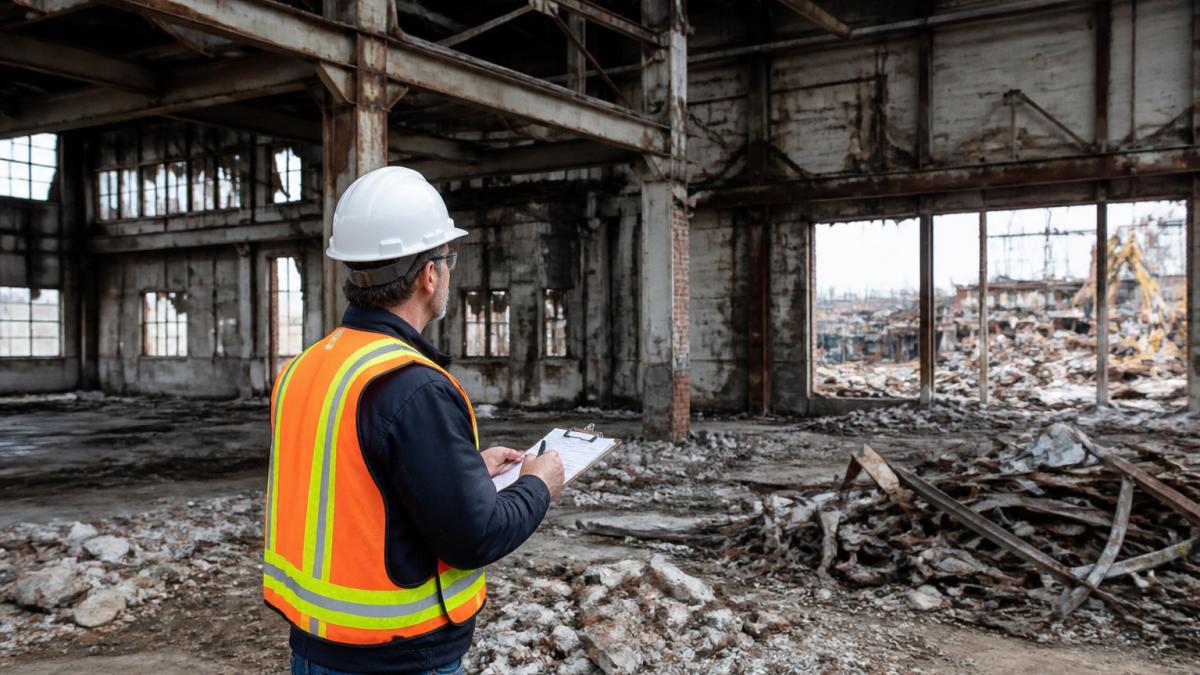
A demolition hazard assessment identifies what could go wrong before the work starts. On an industrial site, it must go further than a generic building survey: it has to account for process equipment, confined spaces, energized systems, hazardous residues, and the facility operations still running next door.
Start with the engineering and structural survey
A qualified professional should confirm which walls, floors, and members carry loads, where hidden voids or weakened connections exist, and what sequence the structure can safely come down in. The survey should record:
- Load-bearing elements and their condition, including corrosion, fire damage, and prior modifications
- Connections that may have been cut, welded, or bolted after original construction
- Floor loading limits for debris accumulation and equipment travel
- Adjacent structures, shared walls, and buried services that could be affected
- Stability of any partially demolished section at each stage
The survey findings feed directly into the demolition sequence. A common pattern is to require the competent person to sign off on structural stability before each major step, not just once at the start.
Inventory industrial-specific hazards
Industrial buildings hold hazards that a residential teardown does not. The assessment should list every one and assign a control:
- Process equipment and piping: tanks, reactors, heat exchangers, and lines that may contain residues, pressure, or trapped product. Confirm isolation, draining, purging, and cleaning before demolition.
- Confined spaces: sumps, vaults, silos, and ductwork that require entry permits, atmospheric testing, and rescue planning.
- Energized systems: electrical panels, transformers, capacitors, and control circuits that may retain stored energy after isolation.
- Hazardous residues: chemical scale, sludge, oils, and contaminated dust that require characterization before disturbance.
- Hazardous building materials: asbestos insulation and fireproofing, lead paint, silica-containing concrete and masonry, and PCB-containing equipment such as old transformers and fluorescent ballasts.
- Operating-site interfaces: live utilities, shared roads, and processes continuing in adjacent buildings that constrain demolition methods and timing.
Each material and system needs its own control method and disposal route. Asbestos, for example, must be sampled by a licensed inspector and removed under the applicable designated-substance requirements before demolition disturbs it.
Rate and assign controls
Rate each hazard by likelihood and severity, then assign a control to every hazard above low risk. Record who is responsible for putting that control in place and how completion will be verified.
Assessments are not one-time documents. Update them whenever new conditions are found, unexpected debris, damaged roofing, a change in weather, or a discovery during stripping that changes the structural picture.
Keep the risk register with the demolition plan and review it at the daily briefing. A hazard that is identified but not assigned to a named person tends not to get controlled.
Utility Isolation, Hazardous Materials and Dust Control
Before any cutting or pulling starts, every utility feeding the building must be isolated and verified dead. Review the Ontario steps for coordinating utility disconnections before demolition begins.
Use lockout and tagout procedures for every energy source. Lock each isolation point, tag it with the name of the worker responsible, and test the line before anyone touches it.
Dust control is equally important. Wet suppression, enclosures, and negative-air units keep particles from spreading to neighboring businesses and into workers’ lungs.
Asbestos and Silica Precautions
Asbestos and silica are two of the most serious hazards on industrial demolition projects. Both can cause lasting lung damage, and neither can be seen with the naked eye.
Before work begins, have a licensed inspector sample suspect materials. Find certified asbestos abatement services for safe removal of hazardous materials. Asbestos removal in Ontario must follow the requirements set by the Ontario Ministry of Labour, Immigration, Training and Skills Development for designated substances. Silica dust from concrete and masonry cutting should be controlled with water and local exhaust ventilation (CCOHS: Health and Safety Report).
Anyone handling asbestos-containing materials should confirm which certification Ontario requires before work begins.
Equipment, PPE and Worker Competency Requirements
Every worker on an industrial demolition site needs documented training for the tasks they perform.
Required personal protective equipment usually includes:
- Hard hats with chin straps
- Safety glasses or face shields
- High-visibility clothing
- Protective gloves matched to the task
- Steel-toe boots
- Hearing protection near heavy equipment
- Respirators when dust or hazardous materials are present
Inspect heavy equipment before every shift. Check hydraulic hoses, brakes, backup alarms, and operator cab protection. Remove any machine with a defect from service until repairs are complete.
Keep training records and PPE inspection logs on site. Inspectors and clients will ask for them, and they prove that every worker was qualified before the job started.
Using a Demolition Site Safety Checklist With Accountable Roles
A site safety checklist turns the plan into daily action. It works best when every item has a named person responsible, a required document, and a verification point, so the checklist becomes a field-ready planning tool rather than a box-ticking exercise.
The table below maps the core requirements to accountable roles. Adapt the role titles to your site, but keep the three columns: someone owns the item, something proves it was done, and someone verifies it.
| Requirement | Accountable role | Documentation | Verification point |
|---|---|---|---|
| Access control and exclusion zones | Site supervisor | Site plan with zones marked; entry log | Start of each shift and after any zone change |
| Structural stability sign-off | Competent person | Signed stability assessment per demolition step | Before each major step |
| Utility isolation and lockout | Utility coordinator | Lockout/tagout log; isolation certificate | Before work near any service |
| Equipment pre-shift inspection | Equipment operator | Inspection log with defects noted | Start of each shift |
| Dust suppression and exposure controls | Environmental lead | Monitoring records; suppression equipment log | Continuous during cutting and demolition |
| Hazardous material removal | Abatement supervisor | Sampling results; removal and disposal records | Before demolition disturbs the material |
| Waste segregation and traceability | Environmental lead | Waste characterization, manifests, and disposal receipts | At each waste transfer |
| Multi-employer coordination | Site supervisor | Pre-task briefing records; permit-to-work log | Before each new task or contractor entry |
| Emergency response readiness | Safety officer | Drill records; rescue plan; contact list | Before first major step and after plan changes |
Coordinate contractors and subcontractors
Industrial demolition usually involves multiple employers on one site. The checklist should include a coordination layer:
- Pre-task briefings: Every contractor attends a briefing before starting work, covering site hazards, exclusion zones, and emergency procedures.
- Shared-site hazard communication: Changes in conditions are communicated to all employers, not just the one that found them.
- Permit-to-work coordination: Hot work, confined-space entry, and work near energized systems are coordinated through a single permit system so two permits do not conflict.
- Stop-work authority: Every worker, regardless of employer, has the authority to stop work when they see an unsafe condition, and the checklist should record that this authority was communicated.
Review and act
Review the checklist at the start of each shift. Anything not checked off should stop the affected work until it is resolved. The safety officer should review incidents, near-misses, and corrective actions weekly, and the site supervisor should confirm that corrective actions are closed out before the next shift.
The checklist earns its keep when each line has a name, a document, and a verification point. That structure is what lets a supervisor prove compliance to an inspector, a client, or a joint health and safety committee without reconstructing the paper trail after the fact.
A practical tip: keep the checklist short enough that workers will actually use it. A one-page daily sheet backed by the fuller risk register and plan is more effective than a binder nobody opens.
Preparing a Demolition Emergency Response Plan
Every industrial demolition site needs a written emergency response plan. Structural collapse, falls from height, fires, chemical releases, and injuries all need a clear response.
The plan should list the nearest hospital, the on-site first-aid provider, and the route emergency vehicles will use.
Practice the plan before the first major demolition step. A short drill with all trades present will reveal gaps that a paper plan cannot.
Booking a Compliant Demolition Project With Manpower Demolition
Industrial demolition is complex, and the safest projects are planned against every requirement before the first machine arrives.
To discuss your project, contact us for current pricing or a quote.
Frequently Asked Questions
What safety requirements apply to industrial demolition in Canada?
Industrial demolition in Canada falls under provincial occupational health and safety legislation, which in Ontario is the Occupational Health and Safety Act and its regulations, including the Construction Projects regulation that governs demolition work. Employers must plan the work, assess hazards, provide training, supply protective equipment and keep records. Requirements vary by province and by the type of structure, so confirm the rules that apply to your site with the relevant provincial authority before work begins.
What should an industrial demolition safety plan include?
A demolition safety plan should describe the scope and sequence of work, the results of the engineering survey and hazard assessment, utility isolation steps, hazardous material controls, exclusion zones, PPE requirements, equipment inspection routines and the names of the people responsible for each task. It should be reviewed with every contractor and subcontractor on site and updated whenever conditions change.
How should utilities be handled before demolition begins?
All electrical, gas, water, sewer and telecommunications services should be identified and formally isolated or disconnected before any structural work starts. Lockout and tagout procedures should be applied, and utility providers should confirm disconnection in writing. Verify isolation on site before anyone begins cutting or removing components.
Who is responsible for worker safety on a demolition site?
Under Ontario occupational health and safety law, the employer, the supervisor and the worker each carry defined duties. The employer provides training and equipment, the supervisor ensures work is carried out safely, and workers follow safe work procedures and report hazards. Clear assignment of these roles in the safety plan prevents gaps in accountability.
Pricing depends on project scope, hazardous material abatement, site access, and schedule, so please request a site-specific quote for current figures.
